Elements of an Autonomous, Agentic Developer
Elements of an Autonomous, Agentic Developer
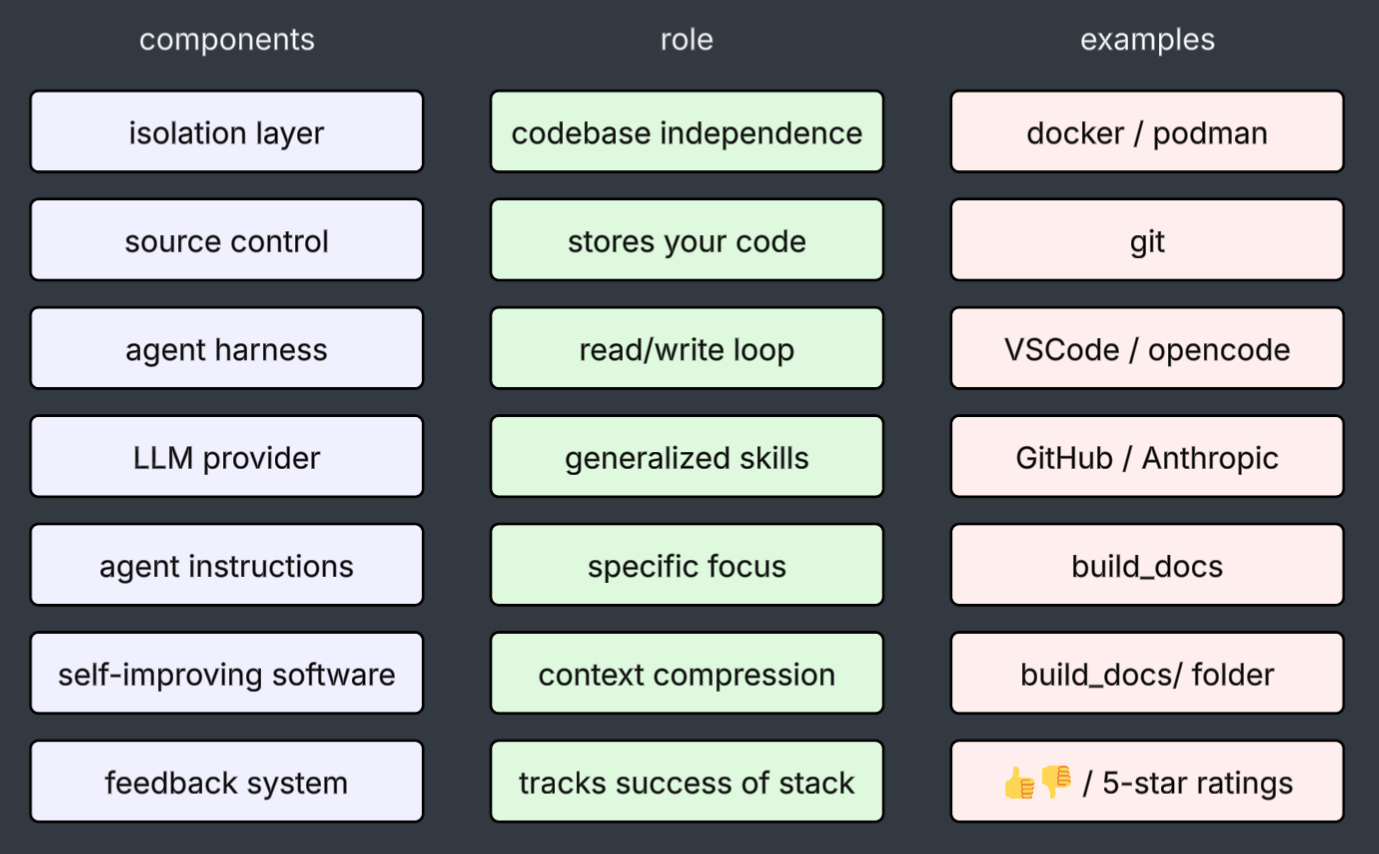
Building an autonomous, agentic developer—a system capable of not just suggesting code but actually executing software engineering tasks from start to finish—requires more than just a powerful LLM. It requires a carefully constructed stack of components that work together to provide context, safety, and direction.
Following the structure of the autonomous developer stack, here are the essential elements:
1. Isolation Layer
- Role: Codebase independence
- Examples: Docker / Podman
To operate safely, an autonomous developer needs a job system that provides clean isolation between the AI and your primary environment. This ensures that the AI's experiments, test executions, and file modifications don't interfere with your main development branch or system stability.
2. Source Control
- Role: Stores your code
- Examples: Git
Source control is the foundation of any development workflow. It allows the agent to manage its own work through branches, worktrees, or another appropriate abstration, providing a clear history of changes and an easy way to revert or merge its contributions.
3. Agent Harness
- Role: Read/write loop
- Examples: VSCode / opencode / Claude
The harness is the primary "worker" that makes changes. The harness is any competent agentic layer that has capabilities such as tool calling, and the ability to iteratively make progress towards the goal stated in the user prompt. It facilitates the essential read/write loop, bridging the gap between your high-level instructions and the AI's concrete actions in the codebase.
4. LLM Provider
- Role: Generalized skills
- Examples: GitHub / Anthropic
At the core of the system is the reasoning engine. You need a robust model provider that offers high-context, low-latency models with generalized reasoning skills capable of complex planning and tool use.
5. Agent Instructions
- Role: Specific focus
- Examples: build_docs / Claude Pilot
An autonomous developer must be able to wear many hats. This layer provides the specific focus the AI needs to play various roles throughout the development lifecycle, such as a Lead Developer breaking down problems or an Implementor writing code.
6. Self-Improving Software
- Role: Context compression
- Examples: build_docs/ folder
Automatically updated documentation is central to an agent's success as codebases become more complex. It acts as a form of context compression, distilling large application details into a high-level map that the agent can use to reason about the entire codebase within its context window. It also enables a powerful technique, Progressive Disclosure, which allows a kind of lazy-loaded capability for adding things to the agent's context window.
7. Feedback System
- Role: Tracks success of stack
- Examples: 👍 👎 / 5-star ratings
To ensure the stack is performing well, you need a feedback system that tracks the success of the agent's tasks. This data is crucial for identifying areas where the model or instructions need improvement. You can use this feedback system to aggregate the right set of tools in a given stack to improve your autonomous developer over time.
Subscribe to Continuous Alignment
Get new posts delivered straight to your inbox.
No spam, just essays on using AI to accomplish more.